Recently, Bitcoin was stuck in a narrow range.
Then, out of nowhere, one of the biggest crypto hacks in history occurred — ByBit was breached, losing over $1.4 billion in ETH.
This was the largest hack ever recorded. Yet, even Ethereum barely reacted, reversing strongly the next day:
This should have been an obvious signal: the market was refusing to drop despite catastrophic news.
Any rational observer would assume that shorting crypto was the wrong move.
Yet, just two days later, both BTC and ETH tumbled significantly — for no apparent reason.
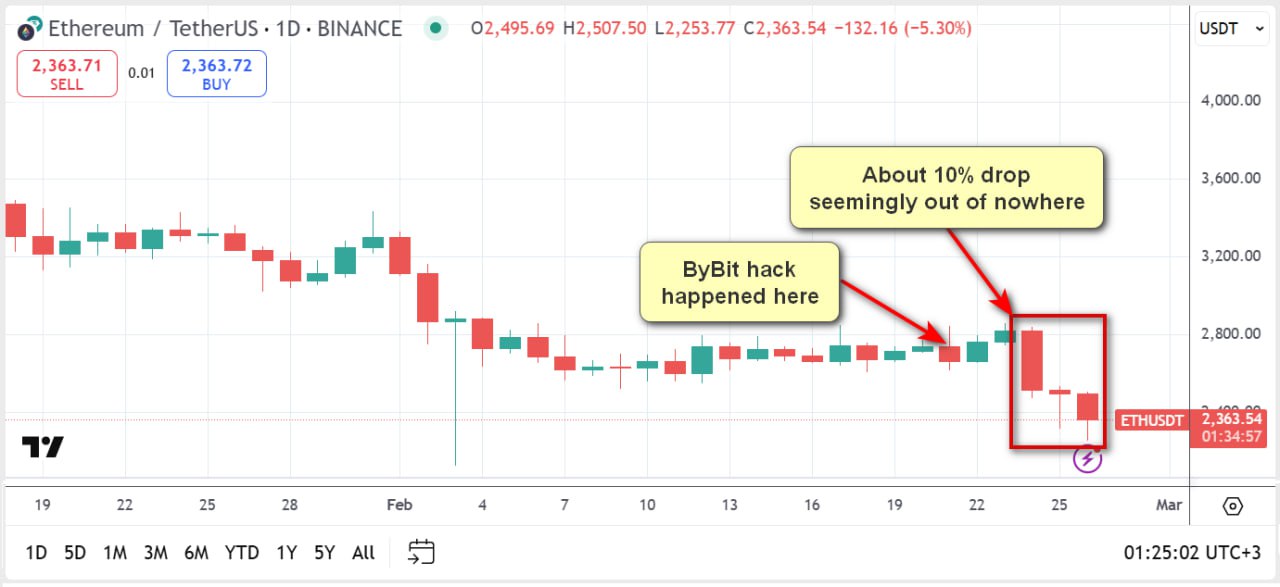
Why?
Because market moves are driven by liquidity, not news.
A quantitative explanation can be found in market microstructure theory, as discussed in The Market Microstructure Theory by Maureen O’Hara.
Prices don’t simply react to news — they shift based on how liquidity providers and large traders adjust their positions in response to order flows, not facts.
Why BTC and ETH didn’t react heavily to the ByBit hack?
No major liquidity providers or leveraged traders were forced to unwind their positions.
But two days later, a seemingly random price drop may have been caused by a cascading deleveraging event, where a large player was forced to exit for completely unrelated reasons.
The market isn’t rational—it’s an ecosystem of traders, funds, and algorithms reacting to liquidity imbalances.
Here's why price moves often have hidden causes:
If we analyze on-chain data and order book imbalances, we would find that the major moves correlate with liquidation levels, not fundamental catalysts.
Historically, large crypto moves have far stronger ties to forced liquidations and hidden leverage than to traditional economic events.
Another explanation comes from market efficiency theory, as outlined in A Random Walk Down Wall Street by Burton Malkiel.
Markets absorb information almost instantly, meaning that any predictable response to news is immediately arbitraged away by high-frequency trading algorithms.
How retail traders are outmatched by algorithms:
Market-making firms and hedge funds deploy machine learning models trained on vast historical datasets.
These models don’t trade based on whether news is “good” or “bad”— they trade on statistical inefficiencies, liquidity flows, and execution strategies.
A retail trader trying to “front-run” the ByBit hack was competing against HFT algorithms pricing in this news in milliseconds.
Some Algocrat AI clients attempted to outthink the market by manually buying BTC at what seemed like a perfect moment — only to see the price collapse days later.
Why manual trading Is a losing game:
Humans are simply too slow.
By the time an event seems to warrant a rational response, market makers, hedge funds, and algorithms have already acted.
The price drop two days after the hack could have been caused by internal portfolio rebalancing by a major institution or a coordinated move by market makers — factors entirely invisible to the retail trader.
The market isn’t irrational — it follows a logic inaccessible to traders who rely on human intuition instead of quantitative models.
What seems like “irrational” price action is actually rooted in complex factors like liquidity flows, hidden leverage, and instant arbitrage opportunities.
In such an environment, relying on human intuition or news-based trades is a high-risk gamble.
That’s why Algocrat AI doesn’t chase narratives:
Instead, it harnesses a momentum-based approach to trading crypto pairs, focusing on quantifiable inefficiencies where real edge lies.
By relying on data-driven signals rather than headlines, it seeks to navigate the market’s hidden logic,
And capitalize on opportunities beyond the grasp of manual strategies,
Delivering "too good to be true" results, for 6 years in a row.
Best regards,
The Algocrat AI Team

